Introduction
The federal government
shutdown, which is truly just a temporary lapse in nonessential programs, has now lasted 36 days. It is the longest shutdown in history.
As the fight drags on, lawmakers must also consider what will come after the continuing resolution (CR). The CR
passed by the House on September 19, 2025, would run through November 21, 2025. This short-term
clean CR (which Senate Democrats continue to block) is intended only as a stopgap measure while negotiations on the full-year spending plan proceed.
Unfortunately, the House, Senate, and White House remain quite far apart on their desired full-year plans, presenting a continued challenge and questions about how to handle the remainder of fiscal year (FY) 2026 discretionary funding.
Where the 12 Bills Stand
There are 12 separate “regular” appropriations bills.
[1] Each chamber has made some
progress on the 12 separate bills. However, none of the twelve has been passed by both chambers in an agreed-upon version.
The House Appropriations Committee has marked up and reported out all 12 bills. The Senate Appropriations Committee has marked up and reported out eight of the 12 bills.
The House has voted on and passed three of the 12 bills. The Senate has also voted on and passed three of the 12 bills, but two of the three bills passed in each chamber are different subcommittees’ bills. Only one, MilCon-VA, has been passed in both chambers, but the differences have not been resolved between the two versions.
This procedural disconnect is the result of a substantive disconnect. There are several major discrepancies in programmatic funding between the House bills and the Senate bills that have been released.
[2] For example, there are entire programs defunded by the House that remain in the Senate’s version.
Adding to this is the significant difference between the
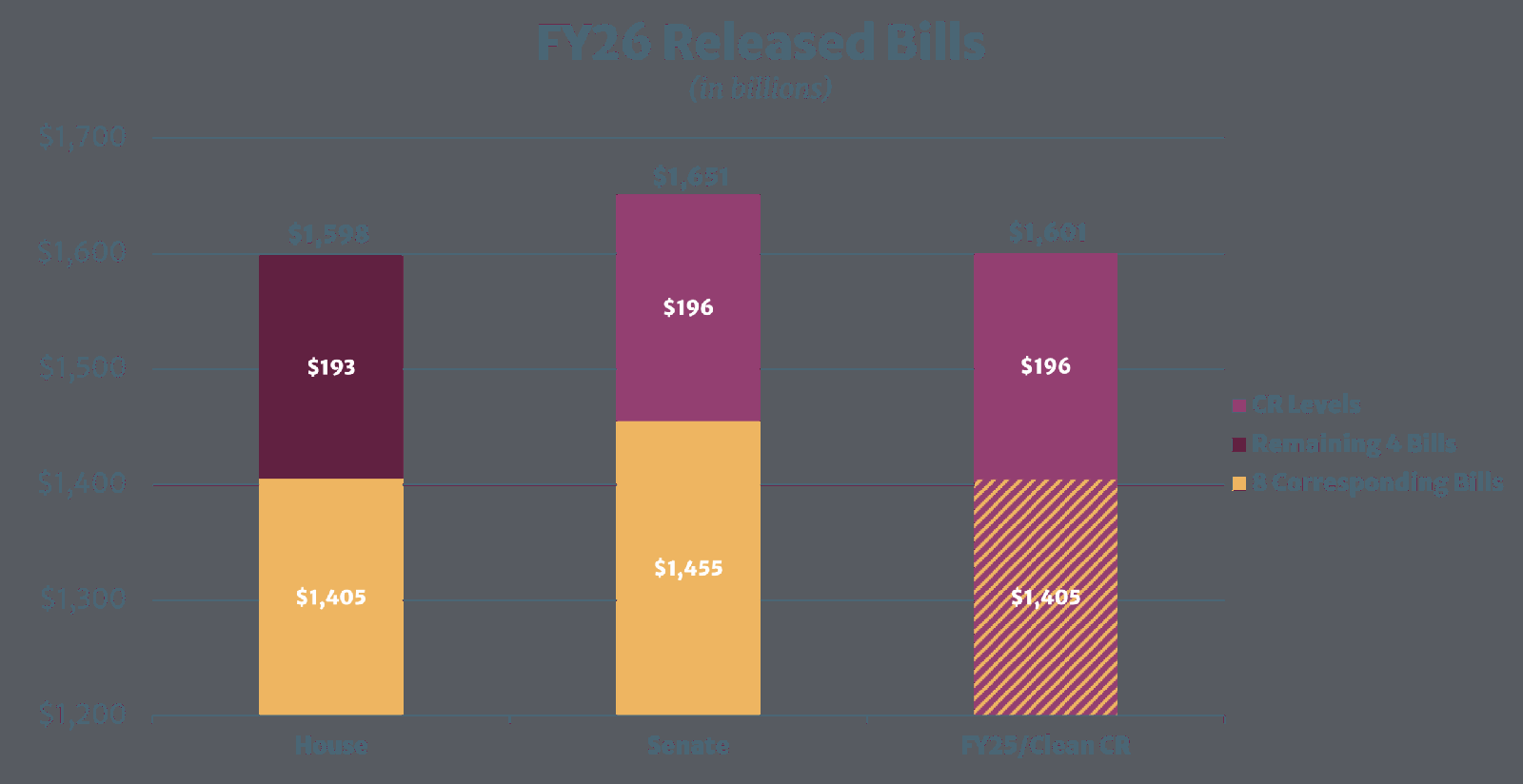
toplines set up by the House, Senate, and President’s Budget Request. The Senate 302(a) topline for the eight reported bills is $50.5 billion more than the House’s topline for those comparable bills. The House’s bills amount to about $2 billion less than FY 2025 spending, while the Senate’s bills increase spending.
Additionally, each chamber has a different set of earmarks included in their bills, with the Senate’s earmarks list much less strictly reviewed than the House’s requests. This has enabled several partisan
poison pills to be added to the Senate bills, including earmarks that fund abortions and gender transition procedures for minors.
A Christmas Omnibus
One process to finalizing full-year appropriations proposed by Senator Appropriations Chair Susan Collins (R-ME) and others would involve a multistep process that rams through Senate Appropriations Bills without consideration for either the House or the White House perspectives. There would be three major steps involved.
Step 1. The plan would combine another short-term CR to December 19 with the three bills already passed in a consolidated vote by the Senate: (1) MilCon-VA, (2) Ag-FDA, and (3) Leg Branch. None of these Senate versions of the three bills has been passed by or formally conferenced with the House. The basic concept is that Congress would enact a short-term CR to get the government to the Christmas holiday, paired with the three Senate-passed bills (thus making it a combination of a CR for nine bills plus a minibus of three, a “CRinibus”).
Step 2. Then, the Senate would theoretically use the next month to gather support for five more bills by Christmas time, when the CR runs out on the nine-bill portion of the CRinibus. Those five bills would be the versions that have already passed the Senate Appropriations Committee (but do not match the House bills): (1) CJS, (2) DOD, (3) Interior, (4) LHHSE, and (5) THUD. Again, there is not assumed to be a formal conference with the House to resolve differences.
Step 3—Scenario A. Before leaving for Christmas break, the Senate would then attach those five bills to a partial full-year CR on the remaining four bills they were unable to move even out of committee: (1) E&W, (2) FSGG, (3) Homeland, and (4) SFOPS. This would be the Christmas CRomnibus rounding out the leftovers of the 12 separate bills.
Step 3—Scenario B. The other potential final step is that Senate Appropriators jam through the unreleased committee drafts of the remaining four bills and attach those to the first five bills from Scenario A. This would then lead to a combined nine-bill package readied for a vote at Christmas.
For FY26 full-year enacted appropriations, this would ultimately leave us with four bills operating under a full-year CR and eight new Senate bills under Scenario A
or 12 Senate appropriations bills that have not been fully vetted under Scenario B.
In either scenario, it is unlikely that Senators or Members of the House would have the time to read the likely thousand-plus page package before voting. While there could be a partial CR tied in, in effect,
this would functionally be an omnibus just in time for Christmas, regardless of what Senate Appropriators call it.
It is also likely that this would be the last train leaving the station for the year and would therefore be loaded up with unrelated riders, authorizations, and additional spending (potentially including a massively irresponsible $410 billion provision making permanent the
Biden COVID Credit Obamacare subsidies).
The proposal also presumes the House would concur with all of the Senate’s actions without putting up a fight, and the President would sign all the various components without insisting on reforms.
It is important to keep in mind that the House has already managed to mark up all 12 of its bills in contrast to the Senate’s eight. Under this plan, the House-marked up and passed bills would largely be ignored, with the possible exception of tacking on the House’s earmarks to the Senate’s list.
More realistically, a foolhardy attempt to engage this plan would result in a secondary shutdown, higher spending, problematic earmarks, and a hodgepodge of spending laws.
Fiscally Responsible Reopening
At this point, the most stable, fiscally responsible plan would be to enact a full-year continuing resolution. This would ensure that higher a 302(a) topline is prevented, while blocking problematic earmarks coming out of the Senate bills. In an ideal world, the House’s more conservative spending bills would be enacted, but the likelihood of that is low given the Senate’s position.
Barring a full-year CR as the immediate next outcome, Congress should at least extend the clean CR into the new year. A CR through January or even into March would release some of the pressure and allow for real negotiations instead of presuming the House will bend to the Senate’s will. House conservatives have
already signaled that they have no intention of simply accepting the Senate Appropriators’ preferences for a bigger-spending, earmark-laden Omnibus in December.
Setting up a second cliff at Christmas adds unnecessary drama to the process, rather than functioning as a serious pathway to enacted appropriations. The House is unlikely to immediately get behind higher topline spending and controversial earmarks out of the Senate; pursuing this plan is more likely to end in a shutdown over Christmas than a tidy set of appropriations wrapped up in a bow.
Prolonging the shutdown or causing a secondary shutdown would be hubris on the part of Senate Appropriators. It is truly unfortunate that a year’s worth of work in the committee will not be enacted, but the situation is dire and refusal to acknowledge political reality will not change the outcome for the better.
Clearing the Decks for Reconciliation 2.0
Ultimately, Congress has a responsibility to
be prudent with taxpayer dollars. This requires discipline and reprioritization, not distractions and unnecessary complications.
A full-year CR would free up legislative time and energy for Congress to refocus on priorities related to reducing and reforming the autopilot (“mandatory”) spending side of the ledger, which comprises
over 73% of total federal outlays.
The most effective and efficient way to address runaway autopilot spending is through a second reconciliation package, which could be used to advance the Trump agenda. Reconciliation 2.0 presents a critical opportunity to continue building on the One Big Beautiful Bill Act’s
wins, and address the nation’s continued fiscal challenges.
To get to that point, though, Congress must reopen the government and move past the discretionary funding stalemate.
[1] The 12 bills are: Agriculture, Rural Development, Food and Drug Administration (Ag-FDA); Commerce, Justice, Science, and Related Agencies (CJS); Defense (DOD); Energy and Water (E&W); Financial Services and General Government (FSGG); Homeland Security (Homeland); Interior and Environment (Interior); Labor, Health and Human Services, and Education (LHHSE); Legislative Branch (Leg Branch); Military Construction and Veterans Affairs (MilCon-VA); National Security–House/State and Foreign Operations–Senate (SFOPS); Transportation, Housing and Urban Development (THUD).
[2] EPIC’s Senior Analyst in Fiscal Policy David Ditch is authoring an ongoing series of analysis pieces comparing the House and Senate versions of appropriations bills. Those already published at the time of this author’s writing include:
Ag-FDA,
CJS,
LHHSE, and
THUD.