

The Congressional Budget Office (CBO) released its newest baseline budget projections on June 18, 2024. The Update to the Budget and Economic Outlook: 2024 to 2034 includes projected federal spending and revenues between fiscal year 2025 to 2034.
The official baseline is often described as reflecting current law, but this is a myth – the CBO is required by law to bias the baseline in favor of higher spending and taxes.
The CBO baseline is important because it is used as the official benchmark against which legislative proposals are scored.
This new report from the CBO should sound the alarm for Congress to get serious about the harm of reckless government spending.
Harmful Consequences of Irresponsible Spending
Excessive and irresponsible government spending has caused inflation to spike at rates not seen in decades. Since January 2021, inflation has grown by 19.3 percent. As the price of gas, groceries, and other things have grown faster than incomes, the dwindling purchasing power has been a painful squeeze on family budgets.
The cornerstone of Bidenomics is a growing federal government that puts Washington politicians and bureaucrats in charge of more and more aspects of the economy and even the most personal aspects of family life. Politicized spending, crushing debt, and burdensome regulations crowd out and distort private investment, slowing economic growth, innovation, and opportunities for workers.
We have gotten used to the ubiquitous Help Wanted signs at local shops and restaurants. There are now 2.9 million missing workers compared to the pre-pandemic normal. Much of the job growth that has occurred recently has been government-sector employment – which is, of course, funded by taxes on the private sector workforce.
As the government’s debt piles up, it can be more difficult and costly for the Treasury to borrow for actual emergencies. As described by EPIC’s President and CEO Paul Winfree, this fiscal space is “crucial for the government’s ability to respond to crises such as war, pandemics, and recessions. However, persistent structural deficits, rising interest costs, and slower economic growth erode fiscal capacity and threaten the nation’s ability to manage future challenges without causing additional harm.”
Spending Projections Surge
The CBO has significantly increased its projected spending since its most recent baseline from February, 2024.
The projected outlays for FY 2024 are now $6.805 trillion, $363 billion higher than what was projected just four months ago. The spending increases are attributable to:
- $145 billion increase in costs due to the Biden student loan debt transfer (misleadingly marketed as debt forgiveness, but in reality, is forcing student loan debt to be paid by taxpayers);
- $70 billion increase in Federal Deposit Insurance Corporation (FDIC) costs due to the 2023 bank bailouts;
- $60 billion increase in discretionary spending, primarily the Ukraine aid supplementals spending bill;
- $50 billion in higher Medicaid costs.
Spending over the FY 2024 – 2034 period is now projected to be $2.6 trillion higher than what was projected in the February 2024 baseline. Revenues are projected to be $120 billion higher over this period.
High Spending Drives Record Debt
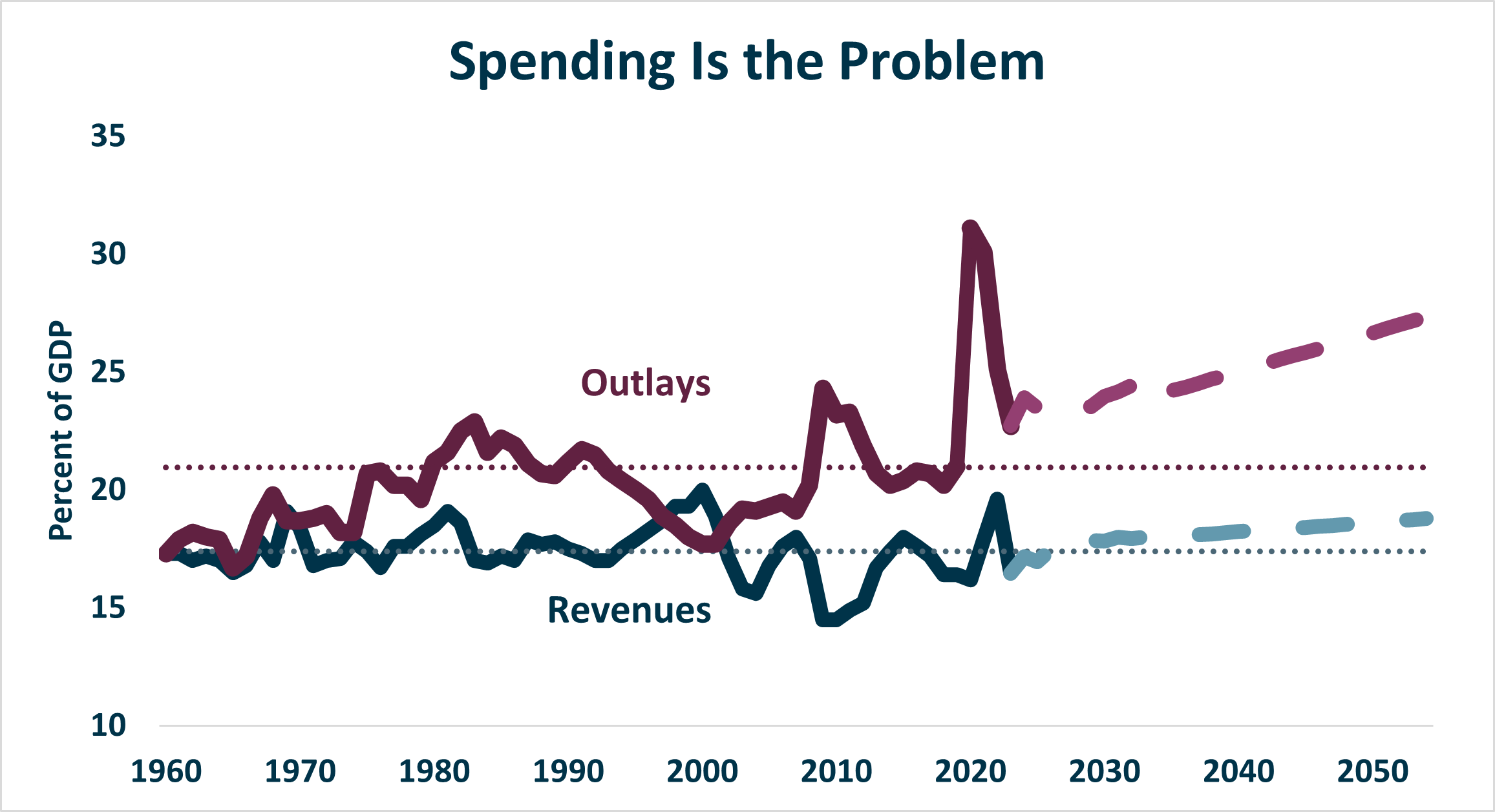
The CBO baseline projects outlays to total $6.8 trillion in FY 2024 (23.9 percent of GDP), rising to $10.3 trillion in FY 2034 (24.9 percent of GDP, see the table below). Over the long term, spending is projected to continue growing as a percentage of the economy (see the graph below).
| CBO’s June 2024 Baseline | ||||||||||||
| 2024 | 2025 | 2026 | 2027 | 2028 | 2029 | 2030 | 2031 | 2032 | 3033 | 2034 | 2025 - 2034 | |
| Outlays | 6,805 | 6,975 | 7,244 | 7,512 | 7,886 | 8,082 | 8,547 | 8,944 | 9,387 | 9,998 | 10,320 | 84,897 |
| Revenues | 4,890 | 5,038 | 5,394 | 5,756 | 5,944 | 6,133 | 6,354 | 6,661 | 6,899 | 7,176 | 7,459 | 62,814 |
| Deficit | 1,915 | 1,938 | 1,851 | 1,756 | 1,942 | 1,949 | 2,193 | 2,283 | 2,487 | 2,822 | 2,862 | 22,083 |
Source: CBO June 2024 baseline.
Spending is well above the historical average of 21 percent of GDP.
Revenues in FY 2024 are projected to be $4.4 trillion (17.2 percent of GDP). This is right about the historical average of 17.3 percent of GDP. Under the current law that assumes the expiration of provisions of the Tax Cuts and Jobs Act, revenues would grow and remain above that historical average. If the TCJA is extended, revenues would be about half a percentage point below the historical average of revenues as a percent of the economy.
The deficit is projected to exceed $1.9 trillion, equivalent to 6.7 percent of GDP in FY 2024.
This excessive spending will drive the national debt to record levels. Debt held by the public is currently about 99 percent as large as the economy. The CBO projects the debt held by the public to reach 122 percent of GDP by 2034.
The debt would surpass its historical record level, set in 1946 in the aftermath of World War II, in FY 2027 when the debt held by the public hits 106.2 percent. After WWII, spending was reduced and the debt fell significantly. However, under the current fiscal path, spending and debt is only projected to keep growing.
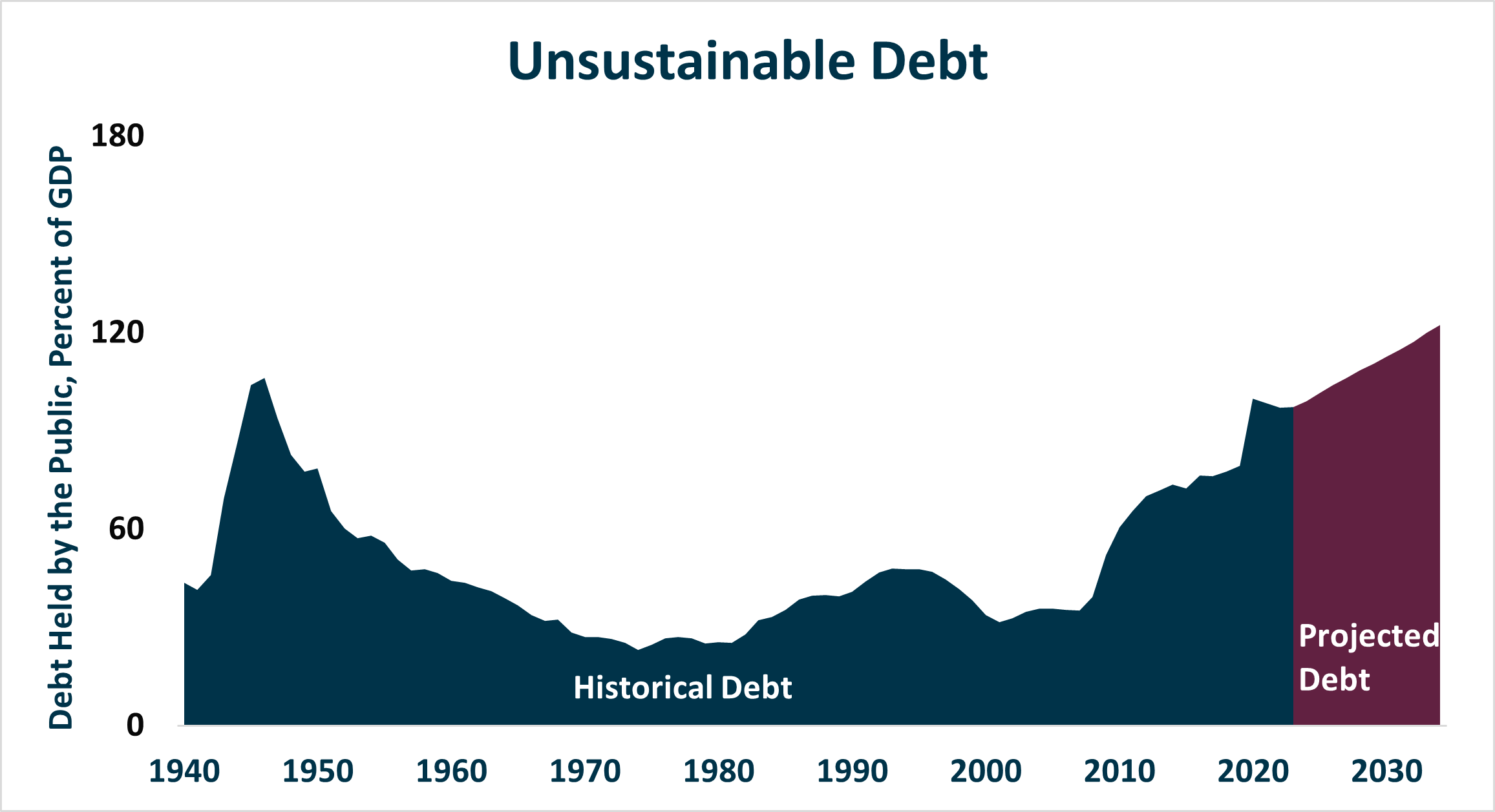
As the debt has grown, so have the interest rates that the Treasury must pay those individuals and organizations that buy our debt. According to CBO, “In 2024, the projected average interest rate on debt held by the public is 3.4 percent—0.7 percentage points higher than it was in 2023 and 1.2 percentage points higher than in 2022.”
However, the CBO baseline assumes that the average interest rate paid remains relatively flat over the budget window, as the projected rate on 10-year Treasury Notes increases while the rate on 3-month Treasury Bills falls. If interest rates are just one percentage point each year above the assumptions in the baseline, CBO projects that outlays would increase by about $3.3 trillion over the next decade.
Costs of Major Programs Including Interest Grow Significantly as Entitlements Reach Insolvency
The CBO projects the largest programs in the federal budget to continue growing substantially and at unsustainable rates.
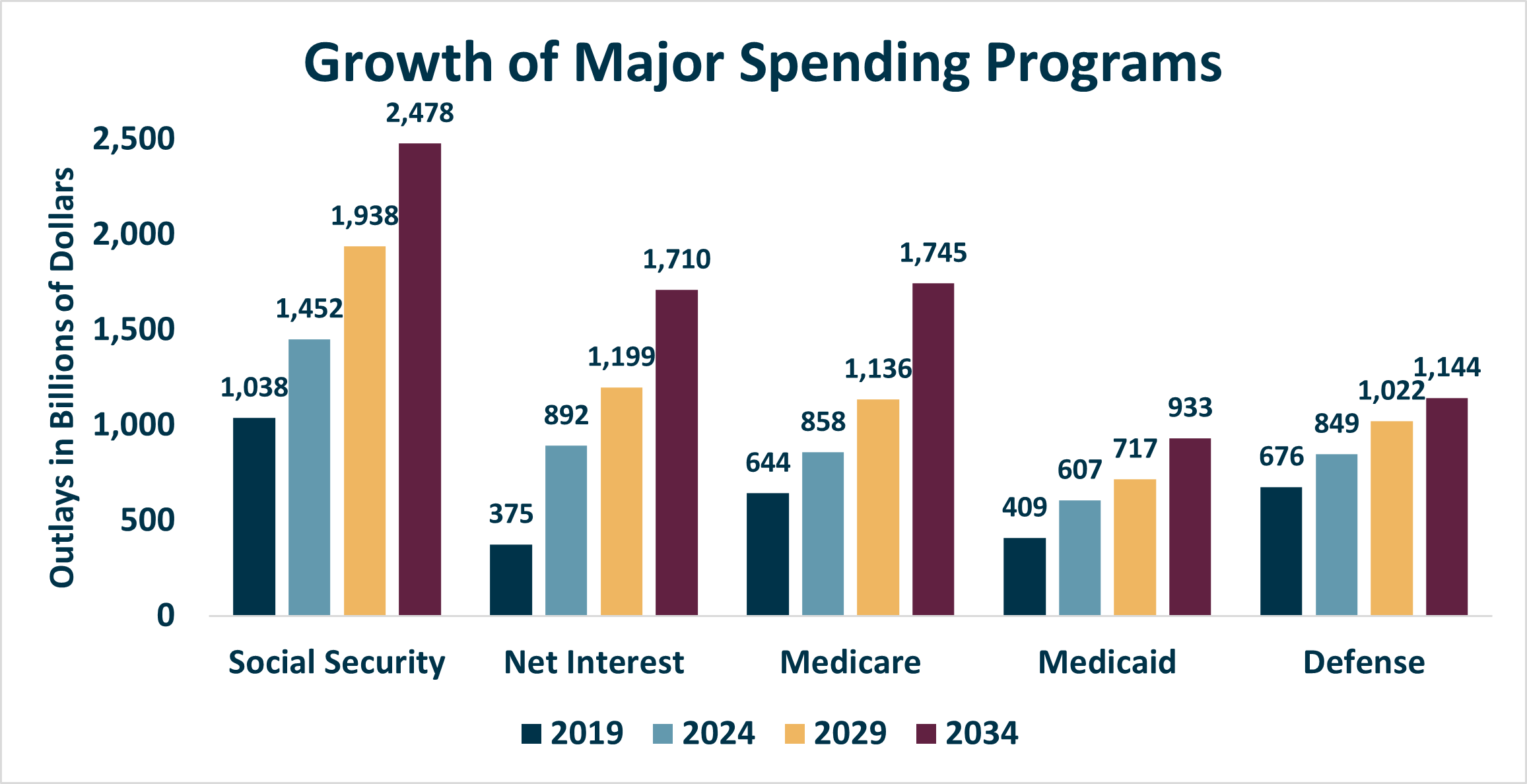
The net interest costs of financing the national debt are now the second largest category of spending in the federal budget, surpassing national defense and Medicare. Interest spending has grown from $375 billion in FY 2019 to $892 in FY 2024 and is projected to reach $1.7 trillion by FY 2034.
Social Security remains the largest federal program, at $1.5 trillion in FY 2024. About $1 trillion in annual spending will by added in the next decade as the Baby Boomers move further into retirement. The CBO projects the Social Security retirement Trust Fund will be depleted by 2033.
Medicare will also grow unsustainably, from $858 billion in FY 2024 to $1.7 trillion in FY 2034. The CBO projects the Medicare Hospital Insurance Trust Fund will be depleted by 2035.
The insolvency of the Trust Funds means that Congress will vote on entitlement reform within the next decade.
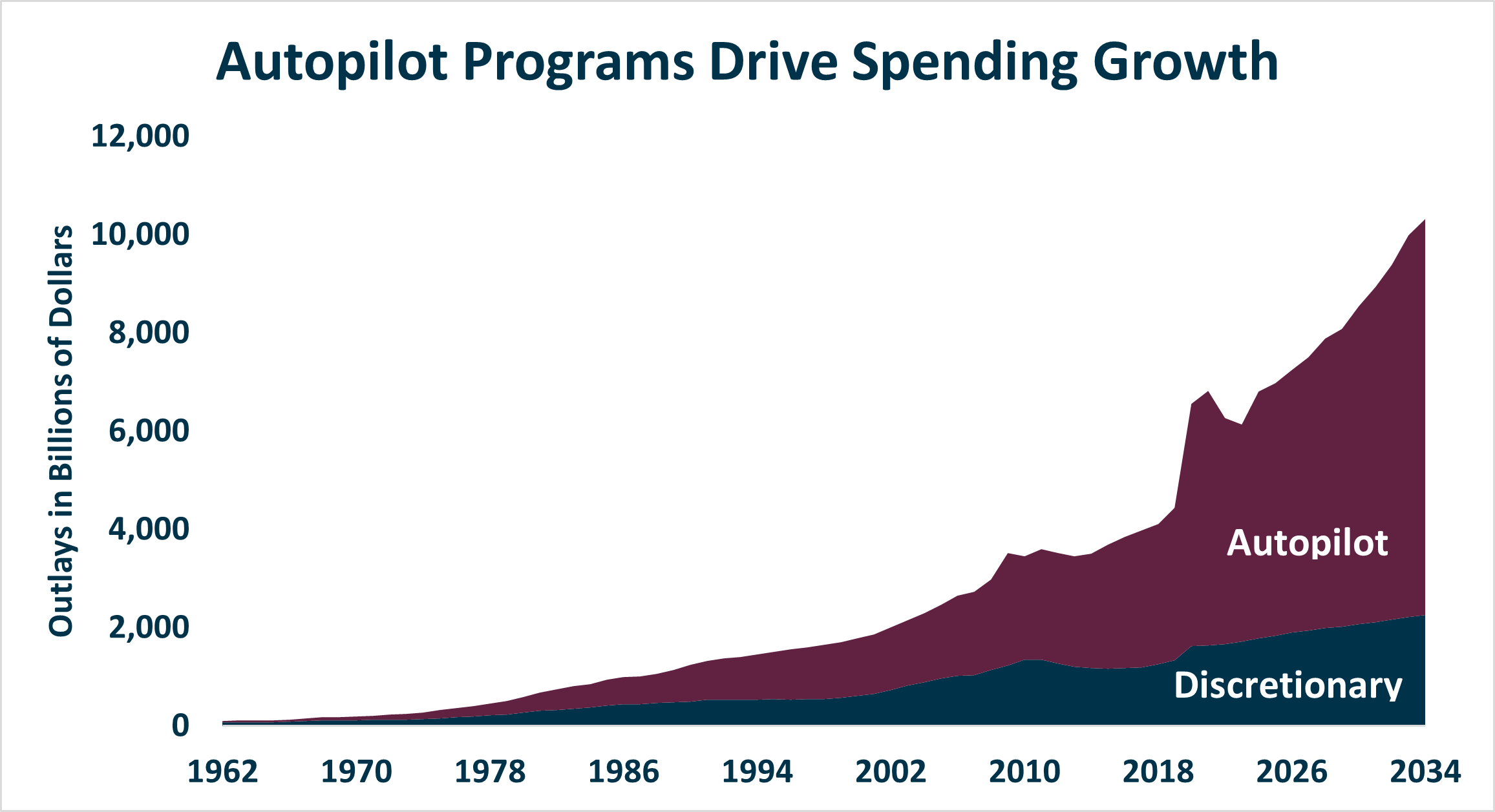
Many of these programs are on legislative autopilot (sometimes misleadingly called “mandatory” spending, although there is nothing required about it) and are not reviewed on a regular basis by Congress. Autopilot spending is projected to grow to 78 percent of the budget by FY 2034, with only 22 percent of spending a part of the annual discretionary appropriations process.
Partial Analysis of the Budgetary Effects of Biden’s Border Crisis
The Update to the Budget and Economic Outlook includes a partial analysis of the budgetary and economic effects of Biden’s border crisis.
The CBO projects that 9.9 million foreign nationals will enter the United States illegally or outside of the normal immigration channels between 2021 and 2026, an average of about 1.65 million per year. CBO estimates net immigration of these aliens to reach 2.4 million annually in FY 2023 and 2024, followed by a decline in FY 2025 and 2026.
This is 8.7 million more of these aliens over this time period than would be previously expected under the CBO’s estimated historical normal of 200,000 per year.
CBO projects that as a result of these policies, revenues would be $1.2 trillion higher over the FY 2024 – 2034 period. Direct spending, including for benefit program payments to these migrants, would be $278 billion higher over the FY 2024 – 2034 period. The CBO did not estimate the effects for discretionary spending costs or other important details. A more complete analysis is forthcoming from CBO.
Get Ready for 2025
The next year will bring some of the most challenging fiscal decisions in modern American history.
In 2025, the debt limit will be reinstated, the 2017 tax cuts for families will expire, the Fiscal Responsibility Act discretionary spending limits will end, and Statutory PAYGO will be enforced.
At the same time, the government’s fiscal situation will continue to deteriorate, with growing spending raising the threat of a debt spiral.
Lawmakers and the next Administration must begin to prepare for the 2025 fiscal cliff. In particular, they should consider how to use the powerful budget reconciliation process to grow the economy, control spending, and implement important priorities for the American people.