Big Changes are Coming in Taxes if Congress Does Not Extend the Tax Cuts and Jobs Act
If Congress does not extend or make the tax cuts permanent, some of the biggest changes to ordinary Americans’ taxes in 2026 will include:
- The Child Tax Credit will be cut in half, from $2,000 to $1,000, and the income level at which the tax credit begins phasing out will fall from $400,000 to $110,000 for married couples.
- The standard deduction will fall by roughly half, from about $15,500 for individuals to about $8,400, and from about $30,900 for married couples to about $16,000. Personal exemptions will return at a level of about $5,300 per individual and dependent.
- Taxes will become more complicated. The TCJA’s doubling of the standard deduction, along with a $10,000 limit on state and local tax deductions, cut the percentage of tax-filers who itemize their deductions by two-thirds, from about 30 percent of filers to just over 10 percent.
- The Alternative Minimum Tax will expand 25-fold. The Alternative Minimum Tax, or AMT, is essentially a fully separate tax code, with limited deductions, that primarily affects higher-income earners. The AMT requires taxpayers to calculate their taxes under two separate systems and pay the higher amount. This not only adds complexity, but also uncertainty and inefficiency as the tax implications of their decisions differ depending on which tax they will pay. Prior to the TJCA, about 5 million taxpayers were subject to the AMT and this fell to about 200,000 households—just 0.1 percent of tax-filers—under the TCJA.
- PEP and Pease will return, taking away exemptions and deductions. The TCJA eliminated two complicated phaseouts for higher income earners. PEP (personal exemption phaseout) phased out personal exemptions for higher income earners while Pease did the same for itemized deductions. These provisions complicated tax filing and decision making by increasing certain taxpayers effective marginal tax rates by anywhere from 1 percent to 10 percent, depending on taxpayers’ income level, household size, and amount of itemized deductions.
- Small business taxes will surge. If the TCJA’s 20 percent exemption on small business income expires (called Section 199A), tens of millions of small businesses will experience large tax hikes. According to IRS data, 47 million Americans reported small business income in 2022; 65 percent of those small business owners had incomes of $100,000 or less and 85 percent had incomes of $200,000 or less.
If Congress Fails to Extend TCJA, Most Americans Will Pay More, But Some of the Highest Income Will Pay Less
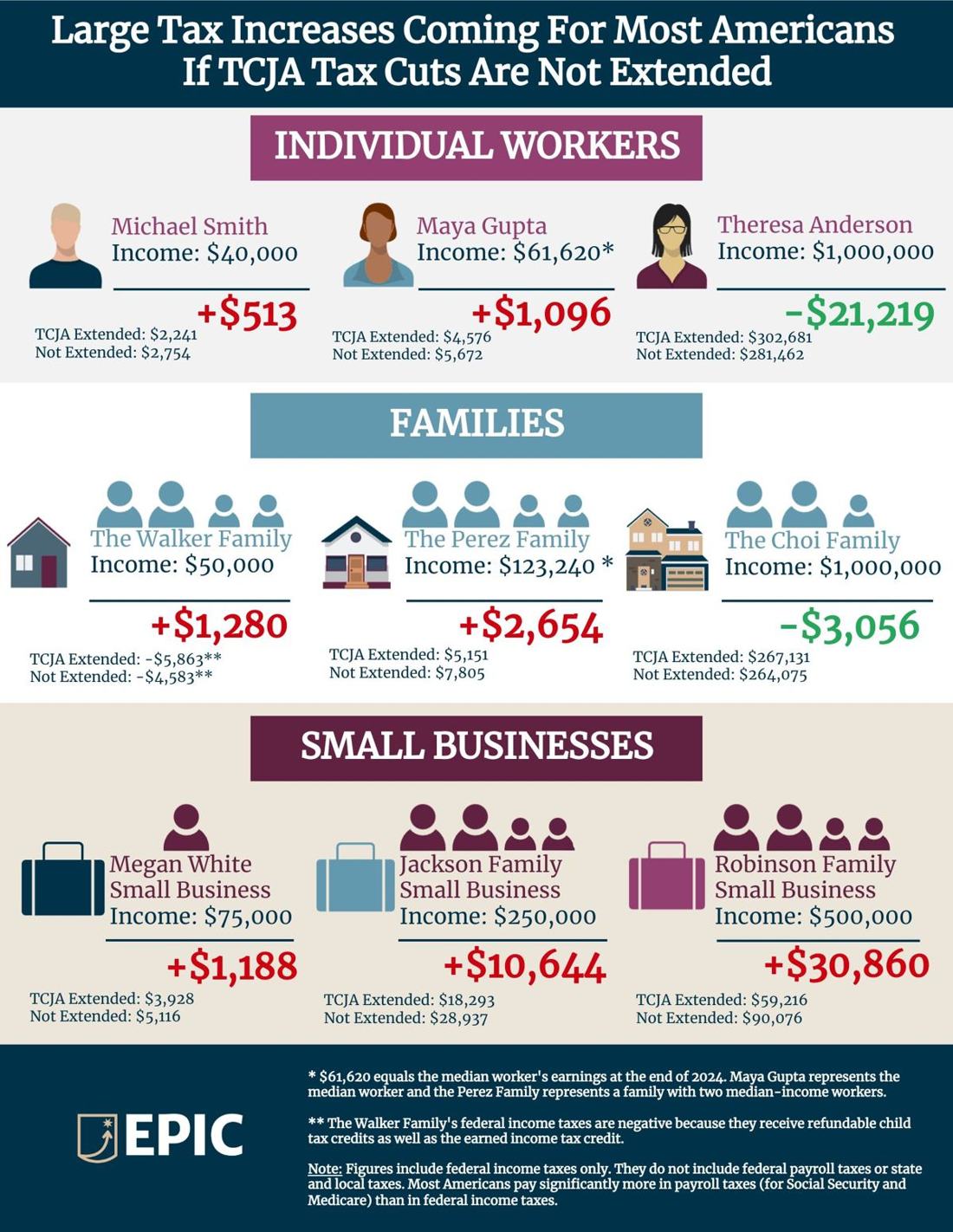
Contrary to the narrative, the TCJA was primarily a tax cut for ordinary Americans. In fact, despite the TCJA cutting the top marginal income tax rate from 39.6% to 37%, some of America’s highest-income earners will actually pay less—not more—if the tax cuts expire because the TCJA broadened the tax base so that
higher-income earners pay taxes on a larger share of their total incomes. As the taxpayer examples below show, Theresa Anderson and the Choi family—both with incomes of $1,000,000—actually pay more today under the TCJA and would receive a
tax cut if Congress does not extend the TCJA.
[1]
On the other hand, nearly all Americans from lower- to upper-income households will experience sizeable tax increases if Congress fails to extend the TCJA, and tax hikes will be largest for families with kids and for small businesses.
Policymakers Should Extend the TCJA and Right-Size Federal Spending
Americans already
pay more in taxes than they spend on housing, food, and clothing combined. Congress should not exacerbate the federal tax burden on working Americans and should make the Tax Cuts and Jobs Act permanent. Extending the TCJA must be coupled with right-sizing federal spending, which has exploded in recent decades. EPIC
has provided dozens of
options that would save trillions of
dollars in
federal spending over the next decade. If Congress cannot rein in excessive government spending, all Americans will eventually pay through high-inflation, European-level taxation (a median worker in Europe pays
nearly $12,000 more per year in taxes than in the U.S.), or a combination of the two.
 [1]
[1] Tax examples are based on author’s calculations and the Tax Foundation’s Tax Calculator available at
https://taxfoundation.org/data/all/federal/tax-calculator-tcja-expiration/.